


DEMINERALISED (DM) WATER TREATMENT PLANT
Demineralization Overview
Demineralization is the sophisticated process of removing mineral salts from water using ion exchange techniques. This process yields demineralized water—water that is either completely or almost free of dissolved minerals. Achieving this high level of purity can involve several methods:
-
Distillation: A process where water is evaporated and then condensed to remove impurities.
-
Deionization: Utilizes ion exchange resins to replace mineral ions with hydrogen (H⁺) and hydroxyl (OH⁻) ions.
-
Membrane Filtration: Techniques like reverse osmosis or nanofiltration that force water through semi-permeable membranes to remove contaminants.
-
Electrodialysis: Employs electric fields to drive ions through selective membranes, separating them from the water.
Demineralized Water, also known as deionized water, is characterized by the removal of mineral ions, such as sodium, calcium, iron, copper (cations), and chloride, sulfate, nitrate (anions). The process of deionization itself is physical, using specially manufactured ion exchange resins that offer ion exchange sites. These resins replace mineral salts with H⁺ and OH⁻ ions, resulting in water of high purity that closely resembles distilled water. Notably, deionization is a swift process with minimal scale buildup.

Demineralization Technology is a proven method for treating water, employing principles such as ion exchange, degasification, and polishing. This technology is widely applied in sectors such as steam generation, power production, process industries, and cooling systems.
Principle: Raw water flows through two distinct beds filled with polymer beads—cation exchange resins in the first bed and anion exchange resins in the second. In the first bed, cations are exchanged with hydrogen ions, while in the second bed, anions are exchanged with hydroxyl ions.
Process: The ion-exchange process is both rapid and reversible, where impurity ions in the water are replaced by ions from the exchange resins. These resins capture the impurity ions and must be periodically regenerated to maintain their effectiveness.
Operational Parameters:
-
TDS Range: DM plants are effective for Total Dissolved Solids (TDS) concentrations between 100 ppm and 600 ppm.
-
Materials of Construction (MOC): Typically, vessels are made of Fiber-Reinforced Plastic (FRP), with common makes including Pentair or equivalent.
-
Pump: Horizontal, centrifugal pumps, such as those from Kirloskar or equivalent, are used.
-
Resin: Resins from brands like Ion Exchange, Purolite, or Chemtex are utilized.
-
Skid: Constructed from Stainless Steel (SS) 304.
Typically, DM plants produce water with a TDS of less than 10 ppm. For applications requiring TDS levels below 5 ppm, a Mixed Bed (MB) unit is recommended after the DM plant to achieve the desired purity.
Types of Ion Exchange Resins
Ion exchange resins are fundamental to the demineralization process, with two primary types tailored to handle different aspects of water purification:
-
Cation-Exchange Resins: These resins are designed to exchange positively charged ions, or cations. In practice, cation-exchange resins release hydrogen ions (H⁺) or other positively charged ions in place of the impurity cations present in the water. This exchange effectively removes cations such as sodium, calcium, and iron, which are replaced by hydrogen ions, contributing to the overall purification process.
-
Anion-Exchange Resins: In contrast, anion-exchange resins target negatively charged ions, or anions. These resins release hydroxyl ions (OH⁻) or other negatively charged ions in exchange for the impurity anions present in the water. This process removes anions such as chloride, sulfate, and nitrate, replacing them with hydroxyl ions, which helps to purify the water further.

Together, cation and anion exchange resins work synergistically in deionization systems to achieve high levels of water purity by removing both cations and anions from the water. Their complementary functions ensure that a broad spectrum of impurities is addressed, resulting in water that is significantly free from dissolved minerals.
Application of Ion Exchange in Water Treatment and Purification
Ion-exchange technology is a versatile tool in water treatment and purification, applied in several effective ways:
-
Cation-Exchange Resins for Water Softening: When utilized alone, cation-exchange resins are instrumental in softening water. This process, known as base exchange, involves the replacement of calcium and magnesium ions—responsible for water hardness—with sodium ions. By doing so, these resins reduce water hardness, thereby preventing scale formation and improving the quality of water for various applications.
-
Anion-Exchange Resins for Organic Scavenging and Nitrate Removal: Anion-exchange resins are adept at targeting and removing specific impurities from water. They are commonly used to remove organic compounds and nitrate ions. By exchanging these anions with hydroxyl ions, anion-exchange resins help in purifying the water and reducing the concentrations of unwanted contaminants such as nitrates, which can pose health risks if present in high levels.
-
Combination of Cation and Anion Exchange Resins for Deionization: For comprehensive purification, a combination of both cation-exchange and anion-exchange resins is employed in a process known as deionization. This method is highly effective in removing virtually all ionic impurities present in the feed water. By using both types of resins, deionization systems achieve an exceptional level of water purity, resulting in treated water with extremely low levels of dissolved ions and minerals.


In essence, the application of ion-exchange technology, whether through individual resins or combined systems, plays a crucial role in achieving high-quality water purification. The result is water that meets stringent standards for various uses, from industrial processes to drinking water.
Deionization
High-purity water is crucial for a myriad of laboratory and industrial applications where even the slightest impurities can affect results or processes. Deionization is a proven method to achieve this level of water purity, ensuring that the water is free from dissolved ions that could compromise its quality.
Types of Deionization
I. Two-Bed Deionization
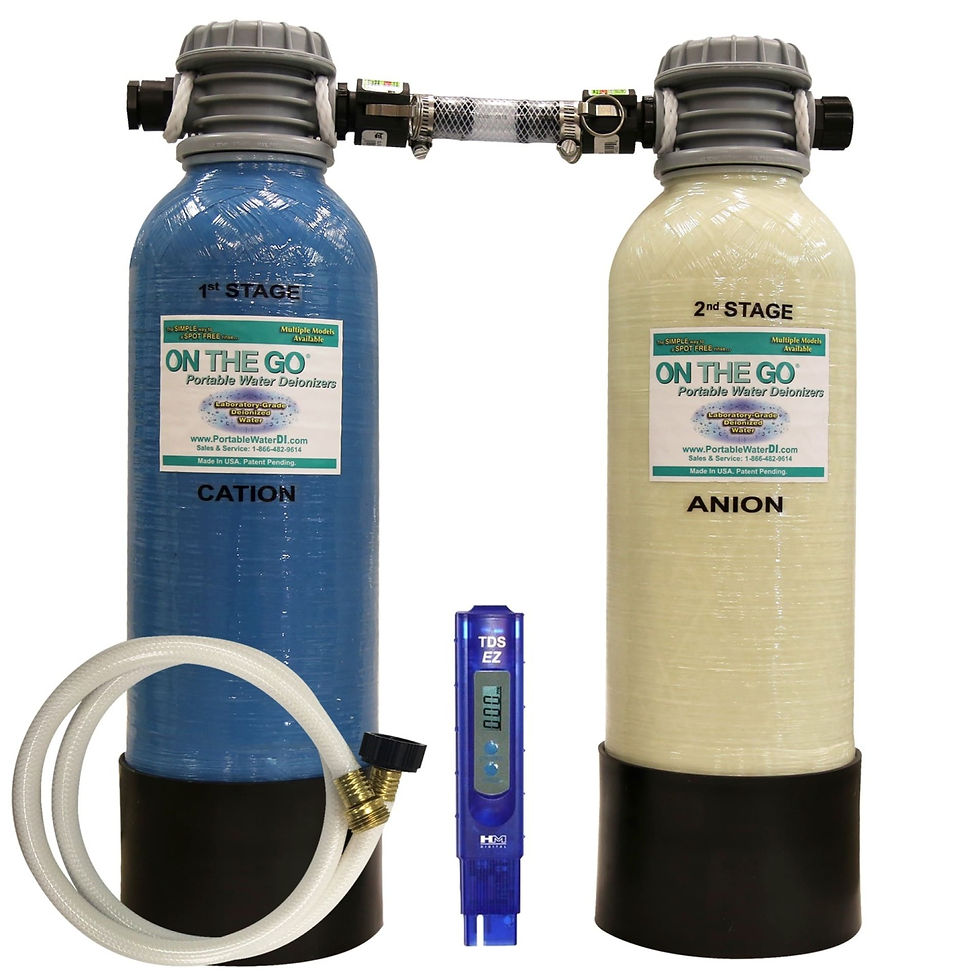
The two-bed deionization system is a widely used technique for achieving high-purity water. It comprises two separate vessels, each filled with a different type of ion-exchange resin, and operates in a sequential manner to purify the water.
-
Cation-Exchange Vessel: The first vessel contains cation-exchange resin in the hydrogen (H⁺) form. As water flows through this cation column, all positively charged ions, or cations, are exchanged for hydrogen ions. To maintain electrical balance in the water, the system adheres to a specific exchange ratio: for every monovalent cation (e.g., sodium Na⁺), one hydrogen ion is replaced; whereas for each divalent cation (e.g., calcium Ca²⁺ or magnesium Mg²⁺), two hydrogen ions are exchanged. This process effectively removes cations, preparing the water for the subsequent stage.
-
Anion-Exchange Vessel: After passing through the cation-exchange column, the decationised water moves on to the second vessel, which contains anion-exchange resin in the hydroxyl (OH⁻) form. Here, all negatively charged ions, or anions, are exchanged for hydroxide ions. This exchange process ensures that the water's anionic impurities are removed. The hydroxide ions then react with the hydrogen ions previously introduced in the cation column to form pure water (H₂O), thereby completing the deionization process.
The two-bed deionization system effectively purifies water by sequentially removing both types of ions, resulting in high-quality water suitable for various critical applications.
II. Mixed-Bed Deionization
Mixed-bed deionization represents an advanced technique for achieving exceptionally high levels of water purity. In this system, both cation-exchange and anion-exchange resins are combined and housed within a single pressure vessel, creating a highly effective purification mechanism.
-
Operation: Unlike the two-bed deionization process, where resins are separated into distinct vessels, mixed-bed deionizers feature a thoroughly mixed blend of cation and anion resins within a single column. This intimate mixture allows the system to function similarly to an extended series of two-bed deionization units, ensuring a more comprehensive removal of ionic contaminants. As a result, the water quality produced by a mixed-bed deionizer is significantly superior to that from a two-bed system, achieving higher purity levels.
-
Efficiency and Sensitivity: The enhanced efficiency of mixed-bed deionizers makes them particularly adept at polishing water to its highest purity. However, this increased efficiency comes with a trade-off; mixed-bed systems are more sensitive to impurities in the incoming water supply. They require meticulous maintenance and regeneration processes due to the potential for resin fouling and depletion.
-
Application: Typically, mixed-bed deionizers are employed as a final step in the water purification process. They are used to polish water that has been initially treated by other methods, such as two-bed deionization or reverse osmosis. By applying mixed-bed deionization as a polishing stage, the water can achieve exceptionally high purity levels suitable for the most demanding applications.

In summary, mixed-bed deionization provides an advanced solution for producing high-purity water, combining the benefits of both cation and anion exchange in a single, efficient system.
Electrodeionization (EDI)
Electrodeionization is a sophisticated technology designed to purify water by removing ions from aqueous streams. Often used in conjunction with reverse osmosis (RO) and other advanced purification systems, EDI systems are renowned for their ability to deliver exceptionally pure water.
Functionality: EDI systems leverage the principles of ion exchange and electrolysis to continuously produce ultrapure water. The process involves passing water through ion-exchange resins within an electrically charged cell. Electrodes applied in the system create an electric field that drives the migration of ions toward respective electrodes. Cations are attracted to the cathode, while anions move towards the anode, effectively removing impurities from the water.
Purity and Operation: The quality of water produced by EDI can reach impressive levels of up to 18.2 MΩ/cm (megohms per centimetre), indicating a very high degree of purity. EDI systems are versatile in their operation, capable of running continuously for uninterrupted production of ultrapure water, or intermittently, depending on operational needs and demand.
Integration with Other Systems: EDI is commonly integrated with reverse osmosis (RO) systems, which pre-treat the water by removing larger contaminants and reducing overall ion content before the final purification stage. This synergy enhances the efficiency of both systems, ensuring that the water reaches the desired purity levels for critical applications.
In essence, Electrodeionization is a key technology for achieving high-purity water in various industries, offering both flexibility and exceptional quality.

Advantages of Electrodeionization Systems
Electrodeionization (EDI) systems offer several notable benefits that make them a preferred choice in various applications:
-
Enhanced Aesthetics and Rugged Design: EDI systems feature a robust and streamlined design that not only improves their visual appeal but also ensures durability in demanding environments.
-
User-Friendly Operation: These systems are designed with ease of use in mind. Their intuitive interfaces and low maintenance requirements make them accessible for operators, reducing the need for extensive training and frequent upkeep.
-
Simplified Distribution and Collection Systems: EDI systems incorporate straightforward distribution and collection mechanisms, which simplify the overall setup and operation compared to more complex filtration systems.
-
Single Valve Operation: Unlike conventional filters that often require multiple valves (up to six), EDI systems operate with a single valve. This single-valve configuration, combined with simplified frontal piping, enhances operational efficiency and reduces potential points of failure.
-
Ease of Installation: The single-valve assembly and simplified piping systems contribute to a more straightforward installation process. This ease of setup not only saves time but also reduces installation costs.
-
Durability and Rust Resistance: EDI systems are built to last, featuring durable, rust-free materials that ensure long-term reliability and minimal maintenance.
-
Energy Efficiency: EDI systems are designed to consume less power, making them more economical to operate compared to other purification technologies.
Overall, Electrodeionization systems deliver superior performance, efficiency, and ease of use, making them a valuable asset for high-purity water applications.
Major Applications of Electrodeionization and Ion Exchange Technologies
Electrodeionization (EDI) Applications:
-
Boilers Feed Water: Ensuring high purity for efficient and reliable boiler operation.
-
Textiles: Providing purified water for dyeing and finishing processes.
-
Pharmaceuticals: Delivering ultrapure water essential for drug production and lab experiments.
-
Chemicals: Purifying water used in chemical formulations and processes.
-
Breweries: Maintaining water purity for consistent quality in brewing.
-
Swimming Pools: Keeping pool water clean and safe.
-
Potable Water: Producing water that meets the highest standards for drinking.
-
Hospitals: Supplying pure water for medical procedures and equipment.
-
Automobiles: Ensuring water quality in cooling systems and manufacturing processes.
-
Battery Production: Providing high-purity water crucial for battery electrolyte solutions.
-
Fertilizers: Purifying water for the manufacturing of various fertilizer products.
Ion Exchange Plants:
-
Water Softeners: Removing hardness-causing ions to prevent scaling in pipes and equipment.
-
Industrial DM Plants: Producing demineralized water for a variety of industrial uses.
-
Two-Stage & Multi-Stage DM Plants: Offering advanced demineralization through sequential processes for enhanced water purity.
-
Mixed Bed Demineralizers: Combining cation and anion exchange resins in a single unit for superior water purification.
-
De-Gasifiers: Removing dissolved gases from water to prevent interference in industrial processes.
-
Cation Polishers: Further purifying water by targeting residual cations after initial treatment.
-
Manual/Automatic Plants: Providing flexibility in operation and control, suitable for various industrial needs.
Industries Served:
-
Pharmaceutical Industry: Ensuring water quality for sensitive production processes.
-
Power Plants: Supplying pure water for steam generation and cooling systems.
-
Oil & Gas Sector: Purifying water for extraction and processing operations.
-
Chemical Industries: Supporting chemical production with high-quality water.
-
Textile Industries: Maintaining water quality for dyeing and other textile treatments.
These technologies play a crucial role across a wide range of sectors, ensuring that water quality meets the stringent requirements of various industrial and commercial applications.